

Aerosols vs. Particles
In recent years, awareness of good air quality has increased significantly. Many studies investigate how air quality affects various areas. Due to the COVID-19 pandemic, indoor air quality, in addition to outdoor air, has become a particular focus.
The SARS-CoV-2 virus is very small (approximately 0.06 to 0.14 µm). However, it is usually not transmitted on its own, but rather via larger solid or liquid particles. In this context, the term “aerosol” has become more widely known. Often, however, it is misused and equated with a mixture of particles.
Since an adult inhales about 100 billion particles daily, it is worthwhile to differentiate more precisely between the terms “aerosol” and “particle” instead of using them synonymously.
Definition Aerosols vs. Particles
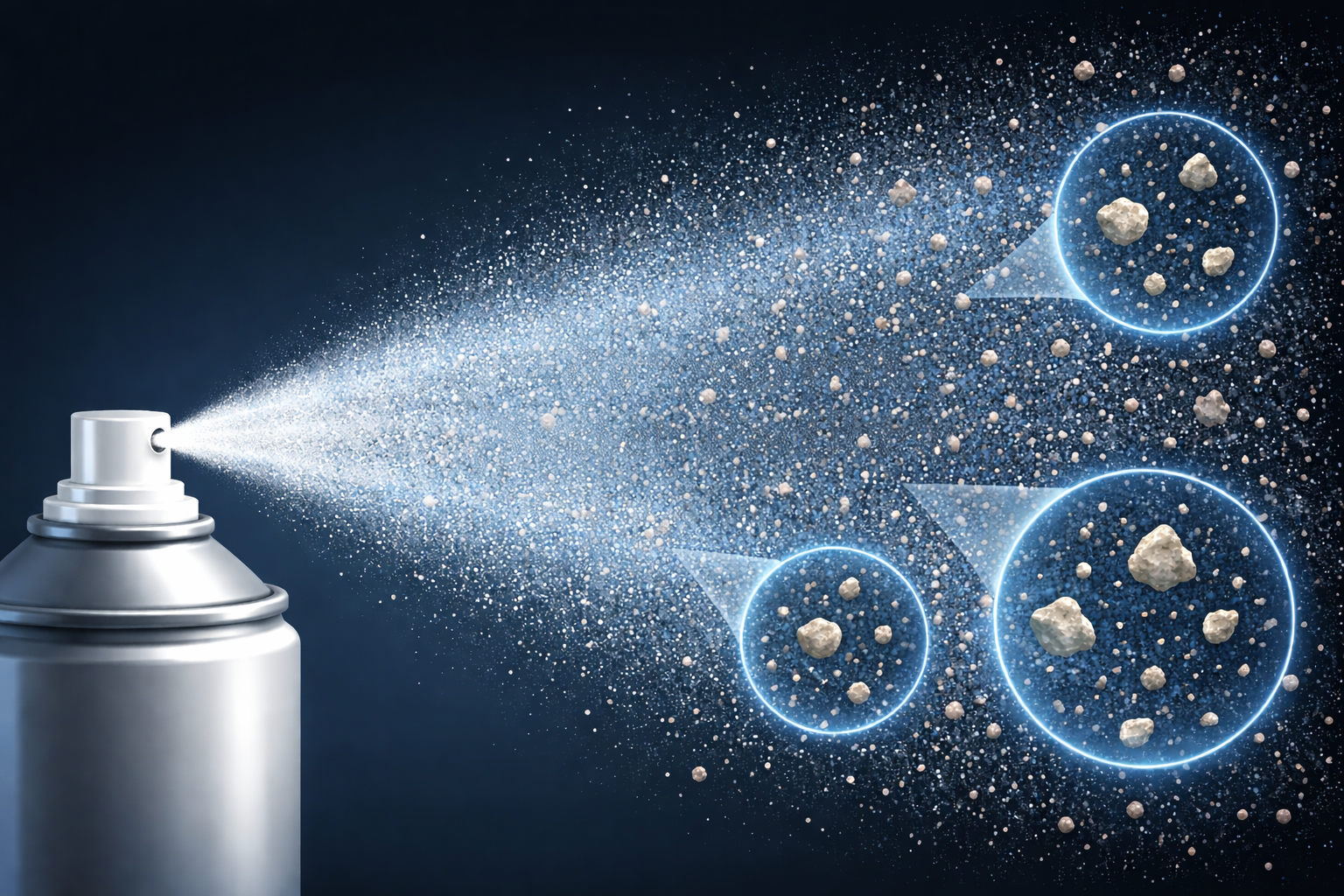
The term “aerosol” is composed of the ancient Greek word for air and the Latin word for solution.
Aerosol is a mixture of a gas and finely dispersed solid or liquid particles (DIN EN ISO 29464:2020). Ambient air is also such a system: Millions of particles can be found in one liter of air.
These particles can remain in the air for hours or even days and exist in solid or liquid form. Their number, size, state of matter, and settling behavior change continuously.
The dynamic behavior of particles in an aerosol
The particles in an aerosol are very small. Their size is in the micrometer or nanometer range. However, this size distribution is not constant but changes continuously. When the size of the particles changes, this also affects their movement in the air and their capture by filters.
One example is liquid particles that people release when exhaling, speaking, coughing, or sneezing. These form droplets with sizes between approximately 0.5 µm and 100 µm.
Approximately 80–90% of these particles are around 1 µm in size and evaporate within milliseconds. Droplets measuring 10 µm evaporate in less than a second. Larger droplets over 100 µm, on the other hand, can remain suspended in the air for more than a minute and usually sink to the ground before evaporating completely.
The rate at which particles settle also depends strongly on their size. In steady air, a 100 µm particle falls from a height of 2 meters at approximately 25 cm per second. Very small particles (1 µm), on the other hand, would take around 16 hours to reach the ground under the same conditions.
Indoors, air movement further extends the residence time of particles. A typical air flow of approximately 0.1 m/s can keep particles in the air for longer.
Furthermore, liquid droplets shrink rapidly due to evaporation. A solid particle with a diameter of 50 µm takes about 30 seconds to sink from a height of 2 meters in steady air. However, a water droplet of the same size evaporates in less than 3 seconds at 50% relative humidity. This means that the droplet has usually evaporated before it reaches the ground.
Conclusion
In some publications, the terms “aerosol” and “particle” are incorrectly used interchangeably. In fact, aerosol is a mixture of a gas (e.g., air) that contains solid or liquid particles. Our ambient air is such a mixture, as it can contain both solid and liquid particles.
It is often assumed that solid particles and liquid droplets move differently. However, their size is the crucial factor. Liquid droplets can evaporate quickly in low humidity and thus become smaller. This changes their settling behavior. In high humidity, on the other hand, particles can absorb moisture, become larger, and sink faster.
Particle size therefore influences both air movement and the effectiveness of various filtration processes. This should be taken into account when selecting suitable aerosol filters.
Team me-Filtertechnik will be happy to assist you in selecting suitable air filter systems for your application and the respective conditions.